The Sharphill Wood invertebrate survey of 2026 was conducted by Julian Smailes, on a pleasant mid-September day. With ivy in bloom in many locations throughout the wood, it was an ideal opportunity to observe some of our insect fauna enjoying the late-season glut of nectar and pollen, a last hurrah for many as the days shorten and the year approaches its end.
Ivy is a critical Autumn resource for many insects, and ivy berries too will keep birds and small mammals going through the Winter months. Insects could be seen on nearly every stand of flowering ivy, with smart ginger-striped ivy bees (fairly recent arrivals in Sharphill) and our more familiar honeybees present in good numbers, as well as several species of hoverfly and drone fly. A few butterflies were also seen in the woods – red admirals feeding on the ivy, and speckled woods pretty much anywhere in the understorey along the central path – but not in great numbers. It is likely that the exceptionally hot Summer will have been disastrous for some of our more common butterflies, with food plants withering and dying in the heat and drought.
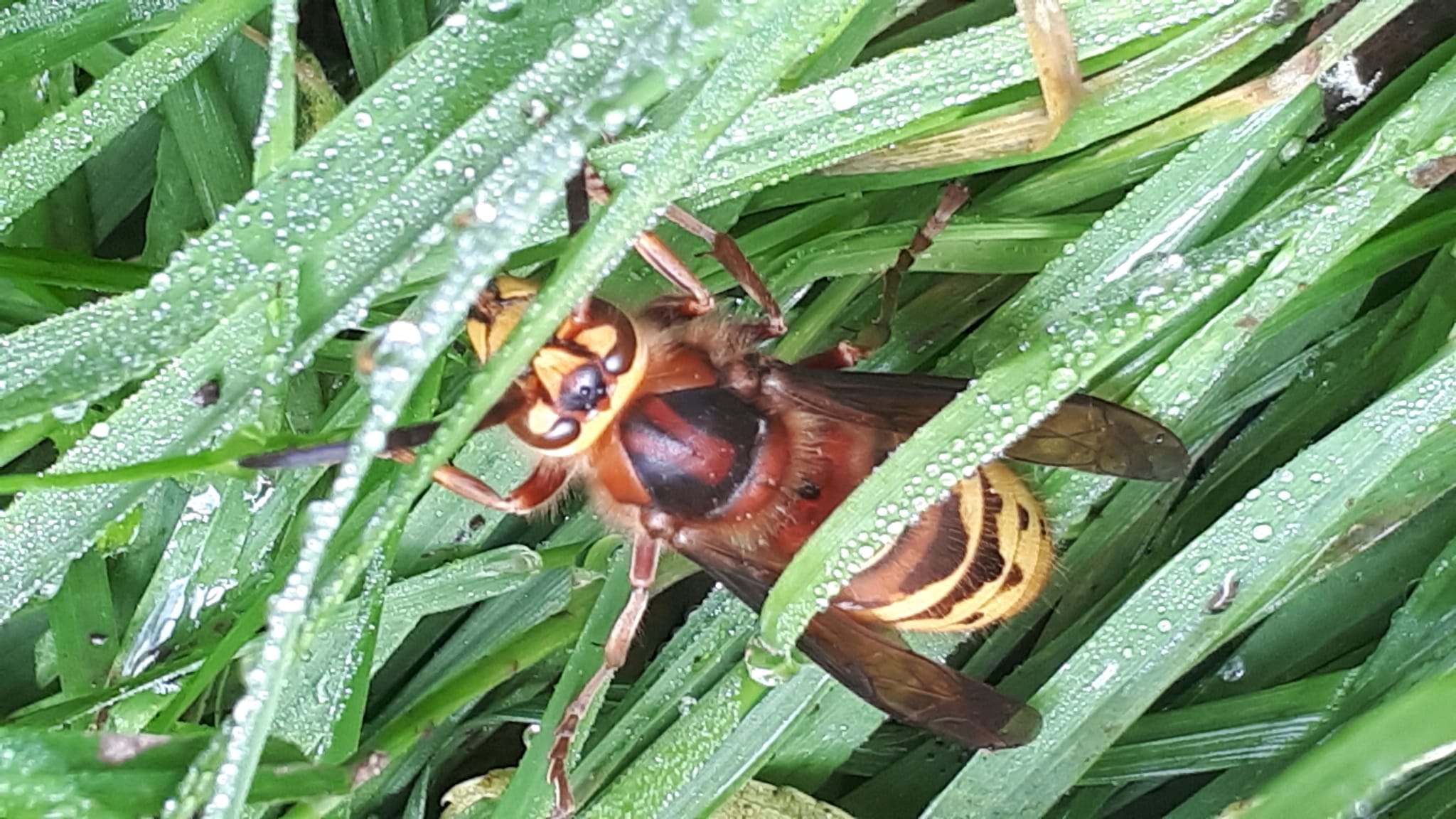
The back end of September and early October sees the nests of various species of social wasp reaching maturity. Common wasps were seen throughout the woods, foraging workers rather than queens or males, but not in great numbers. Sharphill also supports a population of our native European hornets; one or two workers were seen foraging around the eastern side of the wood, and in the planted buffer zone outside the eastern perimeter. Hornets also should soon be reaching their annual peak of activity, with males and reproductive females emerging for their annual nuptials. The males (‘drones’) are likely to be seen loafing around on ivy, in the next week or two. With their purpose fulfilled, all of the males and the sterile female workers will perish with the first frosts of Autumn, leaving just the mated females in hibernation, perhaps concealed under the bark of a fallen tree, ready to emerge in April as next year’s queens.
It’s important to note that European hornets are native to the UK. They’ve been here since the end of the last Ice Age, and are a natural feature of mature woodland. With our climate warming, European hornets have spread northward in recent decades, and have been recorded as far north as Newcastle. The much less welcome non-native yellow-legged or Asian hornet hasn’t yet been seen in these parts, but has probably now established a foothold in the South-East of the country, and may well become resident in due course.
There were plenty of dragonflies to be seen all around the wood, mostly the medium-sized common darter, hunting and basking in the sunshine. One larger dragonfly, a common hawker, was also spotted near the southern entrance to the wood, and an emerald damselfly was also seen.
The next survey will be in Spring 2027.